
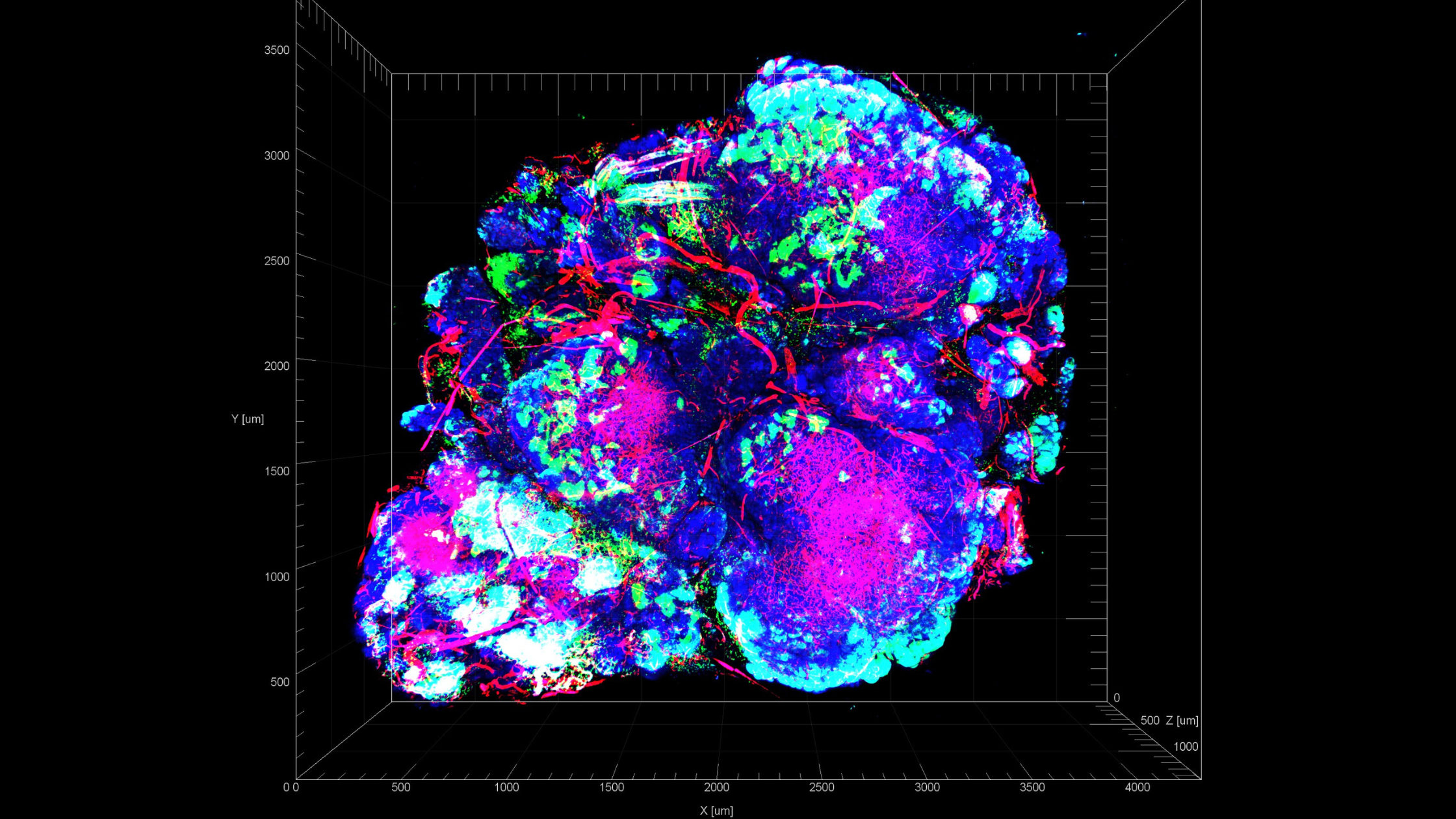
Engineered bacteria are emerging as a novel strategy for cancer therapy. These programmable microbes can selectively target tumors, remain inactive in healthy tissue, and release therapeutic molecules in response to the tumor microenvironment.
Solid tumors are not uniform masses of cells. As they grow rapidly, they often outpace the development of functional blood vessels. This leads to an abnormal tumor microenvironment (TME) characterized by poor blood flow. Because these regions receive little oxygen from the bloodstream, they become hypoxic. At the same time, limited blood supply reduces the delivery of chemotherapeutic drugs. Together, hypoxia and impaired drug penetration contribute to therapeutic resistance and reduce the effectiveness of treatments such as chemotherapy and radiation [1–3].
Key concept: Tumor hypoxia, long considered a therapeutic barrier, may instead serve as a targeting advantage.
Certain bacteria naturally thrive in hypoxic environments. Organisms such as anaerobic Clostridium species preferentially colonize hypoxic tissues and have been studied as potential tumor-targeting agents [4]. Recent advances in synthetic biology and microbial engineering aim to program these organisms to perform therapeutic functions selectively within tumors [5,6].
One of the core challenges has been balancing specificity with safety. Obligate anaerobes can colonize the oxygen-free central regions of tumors but fail to penetrate less hypoxic peripheral zones. To address this, genetic circuits and control systems are being introduced to allow conditional activation of survival or therapeutic functions [6–8].
A major recent advance in this area was reported by Sadr et al. (2025), who constructed and functionally characterized a heterologous quorum-sensing circuit in Clostridium sporogenes [9]. This study demonstrated that programmable gene expression can be achieved in an obligate anaerobe using an engineered communication system. By introducing a synthetic quorum-sensing module, the authors enabled density-dependent control of target genes in a tumor-relevant bacterial chassis. This work provides an experimentally validated framework for integrating population-level sensing with therapeutic gene regulation in hypoxia-colonizing bacteria.
Quorum sensing is a mechanism by which bacteria coordinate gene expression based on local population density: signaling molecules released by individual cells accumulate as a community grows, and once a threshold is reached, target genes are activated [7]. By linking therapeutic gene expression or oxygen tolerance to quorum sensing thresholds, engineered bacteria can be made to respond only after sufficiently colonizing a tumor’s hypoxic core, thereby reducing the risk of activity in healthy tissues [8,9].
These designs take advantage of ecological specificity and programmable control. Instead of attempting to deliver static drugs to a difficult-to-reach location, living therapeutics can sense their environment and adjust activity dynamically. The result is a fundamentally different therapeutic paradigm that operates at the intersection of microbiology, synthetic biology, and oncology [4–9].
Despite the conceptual promise, most studies remain preclinical. Safety concerns such as immune clearance, unintended spread, and precise containment of engineered organisms require rigorous research before human application. Continued technological refinement and regulatory frameworks adapted for living therapies are critical [5,6].
Engineered bacterial therapies do not represent a replacement for existing treatment approaches but rather a novel complement that exploits underused biological niches. By turning a problem of tumor physiology, hypoxia, into an opportunity for selective targeting, this research illustrates how understanding the tumor microenvironment can inform unconventional therapeutic strategies.
References
- Brown JM, Wilson WR. Exploiting tumour hypoxia in cancer treatment. Nat Rev Cancer. 2004;4(6):437-447. doi:10.1038/nrc1367
- Jain RK. Normalization of tumor vasculature: an emerging concept in antiangiogenic therapy. Science. 2005;307(5706):58-62. doi:10.1126/science.1104819
- Shi Z, Li Z, Zhang M. Emerging roles of intratumor microbiota in cancer: tumorigenesis and management strategies. J Transl Med. 2024;22(1):837. Published 2024 Sep 11. doi:10.1186/s12967-024-05640-7
- Lee J, McClure S, Weichselbaum RR, Mimee M. Designing live bacterial therapeutics for cancer. Adv Drug Deliv Rev. 2025;221:115579. doi:10.1016/j.addr.2025.115579
- Ballister ER, Michels A, Vincent RL, et al. The emerging landscape of engineered bacteria cancer therapies. Nat Biotechnol. 2025;43(5):672-676. doi:10.1038/s41587-025-02623-x
- Zhang S, Li R, Xu Y, Liu R, Sun D, Dai Z. Engineered bacteria: Strategies and applications in cancer immunotherapy. Fundam Res. 2024;5(3):1327-1345. Published 2024 Nov 13. doi:10.1016/j.fmre.2024.11.001
- Guo Y, Gao M, Jiang L, Huang H, Kang G, Yu H. Synthetic microbial consortia based on quorum-sensing for disease therapy. Bioresour Bioprocess. 2025;12(1):125. Published 2025 Nov 3. doi:10.1186/s40643-025-00962-w
- Niu L, Deng Z, Jin Y, Guan N, Ye H. Engineering oncolytic bacteria as precision cancer therapeutics: design principles, therapeutic strategies, and translational perspectives. Protein Cell. Published online October 23, 2025. doi:10.1093/procel/pwaf085
- Sadr S, Zargar B, Aucoin MG, Ingalls B. Construction and Functional Characterization of a Heterologous Quorum Sensing Circuit in Clostridium sporogenes. ACS Synth Biol. 2025;14(12):4857-4868. doi:10.1021/acssynbio.5c00628
Photo Credit (public domain): Steve Seung-Young Lee, Univ. of Chicago Comprehensive Cancer Center, National Cancer Institute, National Institutes of Health
#What are engineered bacteria in cancer therapy?
#How do bacteria target tumors?
#Advantages of bacterial therapies over traditional treatments
Ana Correia-Branco, PhD is a placenta biologist specializing in glycomics, proteomics, placental biology, and imaging. Her work focuses on translating complex biomedical research into clear, evidence-based content across pregnancy, microbiome science, and disease mechanisms.
Interested in scientific or medical writing collaborations? Get in touch.




Leave a Reply